

Buying Waterfront Property in Northern Michigan: A Buyer's Guide
Waterfront is the reason many people fall for Northern Michigan in the first place. The blue of Grand Traverse Bay, a quiet inland lake ringed with pines, a river that opens onto the big water. It is a lifestyle worth every bit of the pursuit. It is also a different kind of purchase than a home in town, with its own vocabulary, its own rules, and its own set of questions to ask before you sign.
We help buyers navigate this market throughout the Traverse City region, from the East and West arms of Grand Traverse Bay to Old Mission Peninsula, the Leelanau shoreline, the harbor village of Elk Rapids, and the celebrated Chain of Lakes in Antrim County. This guide walks you through what actually matters when you buy on the water here, so you can move forward with confidence rather than surprises.
The Kinds of Waterfront in Northern Michigan
Not all waterfront is the same, and the differences are not just about the view. The first thing to understand is what body of water you are buying on, because it changes your rights, your responsibilities, and often your price.
- Great Lakes and bay frontage. Grand Traverse Bay is part of Lake Michigan, so bay-front property in the Traverse City area falls under Great Lakes rules. This is the big water: sweeping views, open horizons, and public-trust considerations we will cover below.
- Inland lakes. From small all-sports lakes to quiet no-wake waters, inland lakes give you a more contained, often more private setting. Rights and rules here differ meaningfully from the Great Lakes.
- Rivers and streams. Frontage on flowing water, prized by anglers and paddlers, comes with its own current-related and access-related considerations.
Knowing which category a property falls into is step one. Everything else builds on it.
Waterfront Market by Market
Northern Michigan is not one waterfront market. It is many, each with its own water, its own price, and its own character. Here is how the areas we serve compare.
Traverse City and the Grand Traverse Bays
Traverse City sits at the base of Grand Traverse Bay, where the water splits into an East arm and a West arm. Both are Great Lakes frontage, which means the public-trust and high water mark rules described below apply. East Bay tends toward shallower, sandy, swim-friendly shoreline and a more sheltered feel. West Bay runs deeper and more open, with the city and its marina along the southern shore. In-town and near-town bayfront is some of the most convenient waterfront in the region, within reach of restaurants, the farmers market, and the TART trails.
Traverse City also anchors a cluster of inland lakes just minutes from downtown. Long Lake, Silver Lake, Spider Lake, Green Lake, and Duck Lake offer a quieter, more private alternative to the bay, often at a different price point, while keeping the city close. Boardman Lake sits right in town, now ringed by a completed loop trail.
Old Mission Peninsula
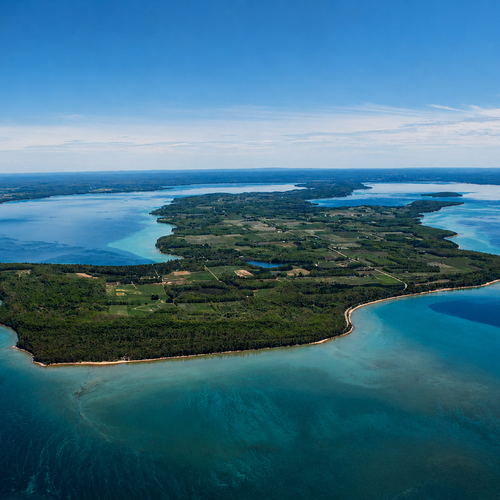
Old Mission Peninsula runs up the center of Grand Traverse Bay, giving it frontage on both the East and West arms. A buyer can choose morning light or evening light, calmer water or more open water, all on the same narrow strip of land. Bay frontage here is Great Lakes frontage, with the shoreline rules that come with it, and the peninsula's scarcity keeps waterfront tightly held. For the full picture of life up here, see our complete guide to living on Old Mission Peninsula.
Leelanau County
Leelanau, the peninsula west of Traverse City, may offer the widest range of waterfront in the region. Its western edge is open Lake Michigan shoreline, including the dunes and beaches around Glen Arbor and Empire near Sleeping Bear. Its eastern edge fronts West Grand Traverse Bay through Suttons Bay and Bingham. Inland, two lakes stand out. Lake Leelanau is one of the largest inland lakes in the state, stretching through two basins and connecting to Lake Michigan by way of the Leland River and Leland's historic Fishtown. Glen Lake, deep and famously clear beneath the Sleeping Bear bluffs, is among the most coveted addresses in Northern Michigan. Villages like Leland, Northport, Suttons Bay, Glen Arbor, and Empire each carry their own character, and wine country runs through all of it.
Elk Rapids and East Bay
Elk Rapids may be the region's finest expression of a waterfront village. Its harbor sits on East Grand Traverse Bay, while an upper harbor connects to the Elk River and, through it, to the Antrim Chain of Lakes. You can walk from a downtown of restaurants, galleries, and a brewery to the water in minutes. Buyers here are choosing bay access and a true village core at once. Waterfront and near-waterfront homes, especially anything with bay views, Elk Lake frontage, or chain access, command a premium, while in-town homes offer a more accessible way in.
Antrim County and the Chain of Lakes
East and north of the bay, Antrim County holds one of the most remarkable freshwater systems in the Midwest. The Chain of Lakes is a connected run of lakes and rivers that stretches for more than a hundred miles of water trail and flows, in the end, into Grand Traverse Bay. The crown jewel is Torch Lake, nearly nineteen miles long and ranked among the clearest lakes in the Western Hemisphere, with turquoise, sandy-bottomed shallows and a famous summer sandbar. Torch waterfront is genuinely exclusive, with true lakefront generally starting well over a million dollars. For chain access at a friendlier entry point, Elk Lake, Skegemog Lake, and Lake Bellaire offer sandy frontage and the same connected boating, often for meaningfully less. The Jordan River adds wild-and-scenic river frontage prized by anglers and paddlers. Villages like Bellaire, Alden, and Central Lake round out the county, with Bellaire's Shanty Creek drawing four-season buyers.
Riparian and Littoral Rights: What You Actually Own
When you buy waterfront, you are buying more than the land. You are buying a bundle of water rights.
Owners of property that borders water hold what are called riparian rights, or littoral rights on larger bodies like the Great Lakes. In Michigan the terms are often used interchangeably. In practical terms, these rights generally include reasonable use of the water, the ability to build a dock, moor a boat, and access the water from your frontage.
The important nuance is what lies beneath the water, known as the bottomlands.
On an inland lake, Michigan law generally recognizes that the waterfront owner holds title to the bottomlands adjacent to their shore, often apportioned toward the center of the lake. That private ownership gives inland owners a higher degree of control, including the general ability to keep others from crossing their shoreline.
The Great Lakes work differently, which brings us to the single most misunderstood point in Northern Michigan waterfront.
The Ordinary High Water Mark and the Public Beach Question
On the Great Lakes, and therefore on Grand Traverse Bay, the state holds the bottomlands in trust for the public. This is called the public trust doctrine. Your private title runs to the ordinary high water mark, the natural line the water reaches over time, rather than all the way to the water's edge.
In the 2005 case Glass v. Goeckel, the Michigan Supreme Court confirmed that the public may walk along the Great Lakes shoreline below the ordinary high water mark, even where that shoreline crosses private property. The public cannot set up on your lawn or use the dry, upland part of your property, but that strip of wet sand between the water and the high water mark is open to pedestrians.
For many buyers this is a genuine surprise. It does not diminish the value or the beauty of bay frontage, and in practice it causes few problems, but you should understand it going in. If a fully private, no-one-else-on-the-sand beach is your goal, an inland lake may fit that vision better than the open bay. We walk clients through exactly what a given shoreline does and does not include.
Docks, Seawalls, and Shoreline Work: The Permits to Know
If you plan to add or change anything at the water's edge, plan on permits.
Shoreline construction in Michigan is regulated by the Department of Environment, Great Lakes, and Energy, known as EGLE. Two parts of state law do most of the work here: the Inland Lakes and Streams program for inland waters, and the Great Lakes Submerged Lands program for the bay and other Great Lakes frontage. Projects on both state and federal jurisdiction can also require a joint application with the U.S. Army Corps of Engineers.
A few practical takeaways:
- Seasonal docks and hoists that go in for the season and come out in fall are treated more simply than permanent structures.
- Permanent docks, seawalls, dredging, and filling generally require review and a permit. Do not assume you can build a permanent structure or harden a shoreline without one.
- Natural shorelines are favored. The state encourages bioengineered and natural stabilization over hard vertical seawalls, which can accelerate erosion on neighboring properties and are increasingly discouraged.
- Existing structures are worth verifying. If a property already has a seawall or a permanent dock, it is worth confirming that it was permitted. That question belongs on your due-diligence list.
None of this should scare you off. It simply means that if your plans include the shoreline, those plans should be checked early, before you are committed.
Great Lakes Water Levels and Why They Matter
The Great Lakes rise and fall in cycles, and the swings are larger than newcomers expect. Within recent memory the lakes hit record lows in the early 2010s and then record highs around 2019 and 2020, before easing back again. A multi-year swing can move the shoreline, change how much beach you have, and put pressure on docks, seawalls, and low-lying land.
This matters for buyers in a few concrete ways. High-water years can shrink or submerge a beach and drive erosion, especially on exposed, west-facing frontage that takes the wind and wave. Low-water years can leave a dock high and dry or expose more bottomland. A property that looks perfect in one part of the cycle may behave very differently in another.
The takeaway is not to fear the water. It is to buy with the cycle in mind. Look at where the home sits relative to the water, ask about the shoreline's history, and factor in setback and elevation rather than assuming today's waterline is permanent.
Reading the Shoreline Itself
Two properties with the same frontage footage can be worlds apart. When we tour waterfront with buyers, these are the things we look at closely:
- Frontage width and how it is measured. More frontage generally means more value and more privacy, but the shape and usability of that frontage matter as much as the number.
- The bottom. Sandy, hard bottom is ideal for swimming. Soft, mucky, or heavily weeded bottom changes how you will use the water. Walk in if you can.
- High bank versus low bank. A low, walk-out shoreline gives easy water access. A high bluff gives dramatic views and privacy but can mean stairs, and it raises erosion questions.
- Orientation and exposure. West-facing frontage rewards you with sunsets but often takes more weather. East-facing frontage can be calmer. Each has trade-offs.
- Erosion and stability. Look for signs of active erosion, undercut banks, or failing shoreline structures. On a bluff, stability is not cosmetic. It is fundamental.
Wells, Septic, and Utilities
Most rural waterfront properties in the region are served by a private well and a septic system rather than municipal water and sewer. That is normal here, and it is manageable, but it deserves attention.
A septic system near the water should be located, inspected, and confirmed to be functioning and appropriately sited. Some counties require a point-of-sale evaluation, and even where they do not, a septic and well inspection is money well spent. Confirm the water source, test the water, and understand the age and condition of both systems before closing.
Flood Risk, Insurance, and Setbacks
Waterfront and floodplain are not the same thing, but they can overlap. Check whether a property sits in a mapped floodplain, since that affects insurance requirements and what you can build. Waterfront insurance in general runs higher than an inland policy, and it is worth getting real quotes early rather than assuming.
Local setback and zoning rules also govern how close to the water you can build or expand. If you are picturing an addition, a new build, or a boathouse, confirm the setbacks before you buy, not after.
Access, Easements, and Shared Frontage
How you reach the property, and who else has rights to the water, can be as important as the frontage itself.
- Private roads. Many waterfront homes sit on private roads. Ask about the road maintenance agreement, who is responsible, and what it costs.
- Deeded and shared access. Some properties are not on the water but carry deeded access to it through a shared easement or an outlot. Understand exactly what that access allows, including whether you can keep a dock or a boat.
- Shared frontage and funneling. Michigan limits the ability of back-lot owners to funnel large numbers of people or boats onto a single narrow strip of frontage. If a property's water access is shared, confirm how many households have rights and what those rights include.
These details live in the deed, the survey, and the association documents. Reading them carefully is part of a good waterfront purchase.
The Financial Picture
Waterfront carries a premium, and a few Michigan-specific financial points are worth knowing before you commit.
- Property taxes can jump after you buy. Under Michigan's Proposal A, a property's taxable value is capped while one owner holds it, then uncaps in the year after a sale. On long-held waterfront, the seller's tax bill may be well below what yours will be. Ask the local assessor for an estimate of your taxes as the new owner rather than relying on the current figure.
- Insurance and upkeep. Budget for higher insurance and for shoreline maintenance. Docks, hoists, and stabilization are ongoing costs, not one-time ones.
- Association dues. On many lakes and in many developments, a lake or property association collects dues and sets rules. Know what they are.
- Rental plans need a rules check. If you intend to rent the property, short-term rentals are regulated locally, and some townships restrict them significantly. Confirm what is allowed for a specific address before you count on rental income.
How Waterfront Buying Is Different: A Quick Checklist
Before you make an offer on Northern Michigan waterfront, make sure you can answer these:
- What body of water is it, and what rights come with it?
- Where does my private property end, and who can use the shoreline?
- Are the existing dock and any shoreline structures permitted?
- What is the shoreline like: bottom, bank, exposure, and erosion history?
- What is the condition of the well and septic?
- Is any part of the property in a floodplain, and what will insurance cost?
- How do I access it, and does anyone share the frontage?
- What will my property taxes actually be after the sale?
- Are my rental or building plans allowed under local rules?
A knowledgeable local agent and, where needed, a real estate attorney can help you work through every one of these. We are not attorneys, and nothing here is legal advice, but we know which questions to ask and who to bring in.
Frequently Asked Questions
Can the public walk on my beach if I own Great Lakes frontage?
On the Great Lakes, including Grand Traverse Bay, the public may walk along the shoreline below the ordinary high water mark, even across private property, under the 2005 Glass v. Goeckel decision. The upland portion of your property remains private. Inland lakes are treated differently, with more private control of the shoreline.
Do I need a permit to build a dock or seawall in Michigan?
Often yes. Permanent docks, seawalls, dredging, and filling generally require review by EGLE, and sometimes a joint permit with the U.S. Army Corps of Engineers. Seasonal, removable docks are handled more simply. Always confirm before you build.
Why would my property taxes go up after I buy waterfront?
Michigan caps a property's taxable value while one owner holds it and uncaps it the year after a sale. On long-held waterfront the increase can be significant, so ask the assessor to estimate your future taxes rather than relying on the seller's current bill.
Are Great Lakes water levels a reason not to buy?
No, but they are a reason to buy thoughtfully. The lakes move through multi-year cycles, so consider elevation, setback, shoreline exposure, and erosion history rather than assuming today's waterline is fixed.
Is inland lake or bay frontage better?
Neither is better. Bay frontage offers big-water views and open water, subject to public-trust shoreline rules. Inland lakes tend to offer more privacy and more shoreline control. The right choice depends on how you want to live on the water.
How do the Traverse City, Old Mission, Leelanau, and Antrim waterfront markets differ?
Traverse City and Old Mission center on Grand Traverse Bay frontage, close to town. Leelanau spans Lake Michigan shoreline, bay frontage, and inland lakes like Lake Leelanau and Glen Lake. Elk Rapids pairs East Bay access with a walkable village. Antrim County is home to the Chain of Lakes, where Torch Lake sits at the premium end and Elk, Skegemog, and Bellaire offer chain access for less.
Thinking About Waterfront in Northern Michigan?
Buying on the water here is one of the most rewarding moves you can make, and it rewards preparation. If you are weighing a specific property, trying to understand a shoreline, or simply mapping out what your budget buys on the bay versus an inland lake, the door is open. Reach out to our team whenever you are ready, and we will help you look at it clearly, from the view all the way down to the bottomlands.
Check out this article next