

Old Mission Peninsula is one of the most photographed landscapes in Northern Michigan, and one of the least understood by the people who photograph it. Visitors arrive in July and August, drive north on Center Road with the windows down, stop at three or four wineries, buy cherries at a farm stand, and leave with the impression of a place that is permanently golden.
Living here is a different proposition, and a better one.
What you notice after the first year is that the peninsula is not scenery. It is a working landscape with a calendar, a set of obligations, and a rhythm that has less to do with tourism than with weather and fruit. The view from a house on Peninsula Drive is beautiful in the way that a farm is beautiful, which is to say it is beautiful because something is happening in it. For buyers considering Old Mission Peninsula real estate, understanding that distinction is the difference between a purchase that fits and one that does not.
This guide is written for people who are seriously researching what it is like to live on Old Mission Peninsula: the daily texture of it, the kinds of property available, what vineyard ownership actually involves, and how value behaves in a market that is far less uniform than it appears from the road.
What It Is Like to Live on Old Mission Peninsula
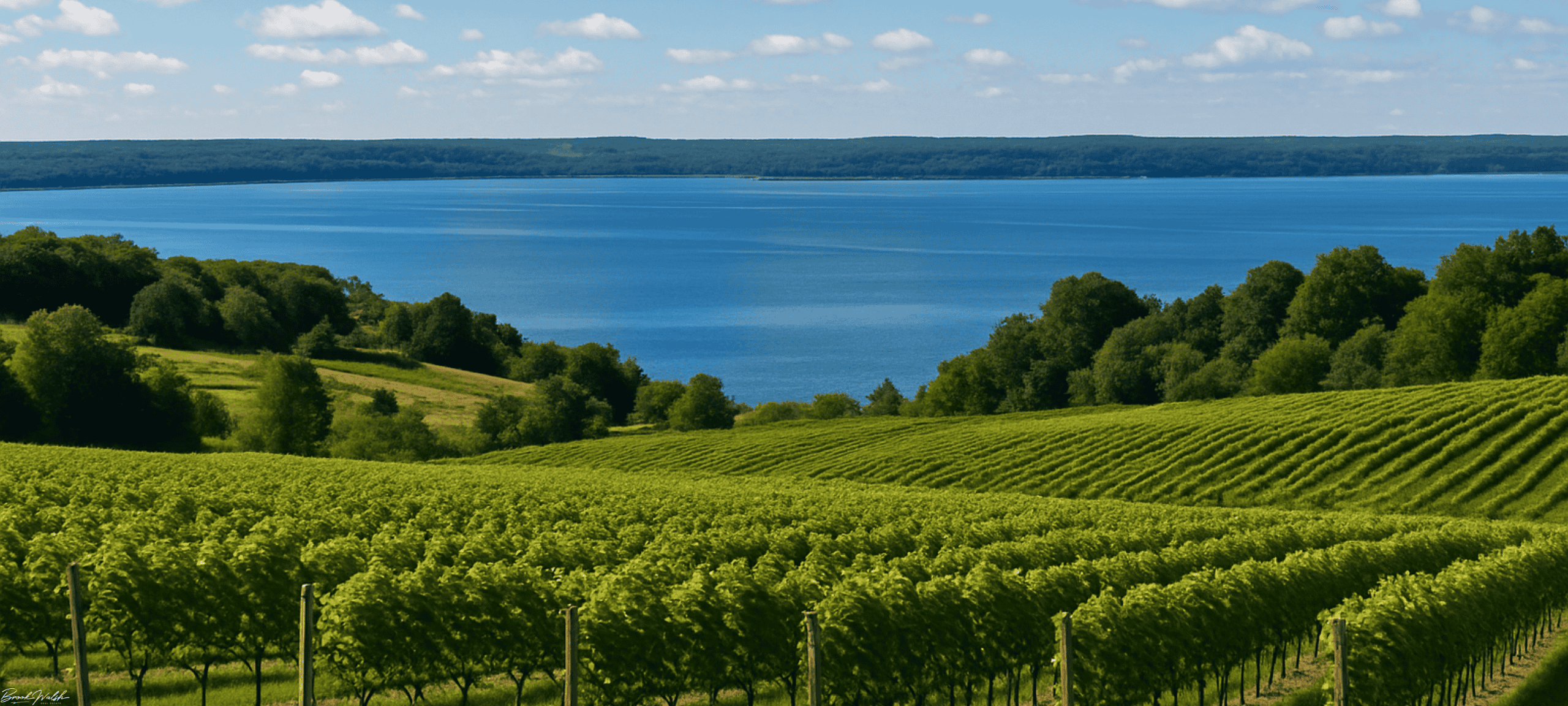
The peninsula runs roughly nineteen miles north from Traverse City, a narrow ridge of glacial hills with East Grand Traverse Bay on one side and West Grand Traverse Bay on the other. At its widest it is about three miles across. From high ground along Center Road, the state highway that runs the spine of the peninsula, you can see water on both sides at once.
That geography governs everything, including the commute. A home near the base of the peninsula puts you eight or ten minutes from downtown Traverse City, close enough that dinner on Front Street is an ordinary Tuesday decision. From the village of Old Mission near the tip, the drive is closer to half an hour, and the character of life changes accordingly. Both are Old Mission Peninsula. They are not the same daily experience, and buyers often discover that they have a strong preference once they have driven the length of it a few times.
The Shape of an Ordinary Day
Daily life here is quieter than people expect. Center Road carries real traffic in summer, but the side roads, Bluff Road, Smokey Hollow, Island View, Seven Hills, Ladd, are narrow, hilly, and largely residential or agricultural. You get used to pulling over for farm equipment. You get used to the sound of a tractor at seven in the morning during spray season, and to the low hum of wind machines on a cold spring night when growers are fighting frost.
You also get used to a certain amount of self-sufficiency. There is one small school, Old Mission Peninsula School, a general store, a handful of restaurants, and the wineries. Everything else is in town. Most residents keep a well-stocked pantry and a mental map of which farm stands are open when.
The Seasons Set the Calendar
The peninsula has four distinct seasons and each one looks entirely different from the road.
Spring is tense and beautiful. Cherry and apple blossom cover the hills in May, and growers watch the forecast obsessively, because a late frost at the wrong moment matters enormously. Summer is green and busy, with boats on both bays and the wineries at full capacity. Harvest runs from late summer into October and is the most alive the peninsula ever feels: picking crews, gondolas of fruit moving down Center Road, the smell of fermentation near the wineries, vineyard rows turning gold and rust.
Winter is the season that separates people who love the peninsula from people who love the idea of it. The bays rarely freeze completely, the light goes low and silver, the vines are bare and pruned, and the roads get genuinely quiet. Many residents consider it the best time of year. It is worth visiting in February before you buy.
Why the Land Grows What It Grows
Old Mission Peninsula became an American Viticultural Area in 1987, and the reason is geography rather than marketing.
The peninsula sits at roughly the 45th parallel, the same latitude band that runs through Bordeaux, Piedmont, and the Willamette Valley. Latitude alone would not be enough this far inland. What makes the difference is water. West Bay reaches depths of more than 400 feet and East Bay more than 600 feet, and the peninsula is narrow enough that nearly every acre of it sits close to deep, slow-to-change water. That mass of water holds the peninsula back in spring, delaying bud break past the worst of the frost risk, and holds warmth into autumn, extending the ripening season well beyond what the surrounding region gets.
The soils are glacial: sandy and gravelly loams over clay pockets, with limestone influence, draining fast on the slopes. Cool-climate varieties do best here. Riesling is the peninsula's signature, with Chardonnay, Pinot Gris, Pinot Blanc, Gewürztraminer, Pinot Noir, Cabernet Franc, Merlot, and Gamay planted in meaningful acreage.
Ten wineries operate along the Old Mission Peninsula Wine Trail, among them Chateau Grand Traverse, Chateau Chantal, Brys Estate, 2 Lads, Mari Vineyards, Bowers Harbor Vineyards, Peninsula Cellars, Hawthorne Vineyards, Tabone, and Black Star Farms, with Bonobo also on the peninsula. Cherries and apples remain a major part of the agricultural picture, and many vineyards sit on ground that was orchard within living memory.
For buyers coming from other wine regions, the scale here is worth naming plainly. The entire appellation is small. It is not Napa and it does not behave like Napa. Jacquelyn Olson, who lived in Napa Valley, Sonoma, and Bordeaux before Northern Michigan and whose husband is a winemaker, describes the comparison as instructive rather than aspirational. Old Mission is closer in feel to a working European agricultural district than to a destination wine economy, and buyers who want that distinction understood tend to be happier here.
Why Buyers Are Drawn to Old Mission Peninsula
The buyers who commit to this market usually cite some version of the same three things.
The first is the combination of privacy and proximity. Ten minutes from a real town with an airport, a hospital, restaurants, and a symphony, and yet surrounded by orchards and vines. Very few places in the country offer that ratio.
The second is that the landscape is protected in a way that is unusually durable. Peninsula Township created one of the first publicly funded Purchase of Development Rights programs in the country in 1994, and voters have renewed the millage twice. Between PDR easements, land conservancy holdings, and public land, roughly 6,000 acres, about a third of the township, carry permanent protection from development. The view from most properties here is not protected by luck. It is protected by recorded easements.
The third is agricultural authenticity. People want to live somewhere that still grows things.
The Range of Old Mission Peninsula Real Estate
One of the most common mistakes buyers make is treating Old Mission Peninsula homes for sale as a single category. The inventory is small and remarkably varied.
Waterfront and Water View
True water frontage on East Bay or West Bay is the scarcest asset on the peninsula, and the two bays are not interchangeable. East Bay frontage often means sunrise light and, in stretches, sandier, shallower entry. West Bay frontage tends toward sunset light, with Power Island and the Leelanau shoreline on the horizon. Bluff position, bank height, stairway access, shoreline composition, and exposure to prevailing wind all vary within a few hundred yards.
Water view properties are a separate market. A ridge home with a broad bay view and no frontage can be more compelling to some buyers than a low-bank waterfront home with a narrower outlook, and price does not always follow the intuition.
Acreage and Agricultural Parcels
Acreage on the peninsula ranges from a few open acres behind a house to substantial agricultural parcels, some with vines or orchard in production, some leased to neighboring growers, some fallow. Acreage for sale on Old Mission Peninsula frequently carries a conservation easement or a PDR restriction, which shapes what can be built and where. That is not a defect. It is often the reason the parcel looks the way it does. It does need to be understood before an offer, not after.
Homes Among the Vineyards
Established homes surrounded by vineyard and orchard land are the quiet center of this market: farmhouses that have been thoughtfully renovated, mid-century houses on good ground, and homes built by families who farmed here. You will also find newer luxury homes on carefully chosen sites, architect-designed and sited for view and light, and a small number of historic and character properties near the village of Old Mission and along the older road corridors. Condition, architecture, and siting vary enormously, and so does the quality of the land underneath.
Owning Vineyard Property on Old Mission Peninsula
A vineyard property is not a house with an unusually attractive yard. It is agricultural land, and agricultural land comes with conditions, obligations, and a long time horizon.
Ted Schweitzer and Brad Bickle have both owned vineyard property on Old Mission Peninsula, which means their advice comes from having lived with the questions rather than having read about them.
The Land Itself
Soil type and depth, slope, aspect, drainage, and elevation determine what a site can ripen and how reliably. South and west-facing slopes behave differently from north-facing ones. Low ground collects cold air and carries more frost risk than a hillside a few hundred feet away. Two parcels on the same road can have materially different growing potential.
Vines, Infrastructure, and Operations
If vines are already planted, the relevant questions are variety, rootstock, age, spacing, trellis condition, vine health, and yield history. If they are leased or farmed by a third party, the terms of that arrangement matter. Beyond the vines: water supply, irrigation, electrical service, equipment access, outbuildings, road frontage, and drive access in winter.
If there is no vineyard and the appeal is potential, the honest answer is that potential is a hypothesis until it has been evaluated by people who assess vineyard sites for a living.
Zoning, Easements, and Permitted Uses
Peninsula Township's land use framework is specific, and the relationship between agriculture, residential use, and commercial activity on the peninsula has been the subject of sustained public and legal attention in recent years. What a given parcel permits, whether it is encumbered by a conservation easement, how many building envelopes it retains, and what agricultural or commercial activity is allowed are parcel-specific questions with parcel-specific answers.
None of this is legal, tax, agricultural, or financial advice, and it should not be treated as a substitute for it. Anyone buying vineyard or agricultural property here should conduct thorough due diligence with qualified professionals: a real estate attorney, a viticultural or agricultural consultant, a surveyor, the township, and an accountant familiar with agricultural property. Our role is to make sure the right questions get asked early, while there is still time for the answers to matter.
This Is a Working Agricultural Community
Buyers should understand what they are buying into, and the best outcomes come from people who want it rather than tolerate it.
There are tractors on the road. There is spraying, sometimes early, sometimes in conditions that are inconvenient for a dinner party. There are crews in the rows at harvest, equipment running late, trucks moving fruit, wind machines on frost nights, and bird cannons in some areas as the crop ripens. Michigan's agricultural operations have meaningful protections, and farming here predates nearly every house on the peninsula.
Residents who love it describe these things as evidence that the place is real. If the sound of a tractor at dawn in June would be a grievance rather than a reassurance, the peninsula is probably not the right fit, and that is useful to know before you write an offer rather than after.
The Lifestyle Beyond the Wineries
Wine is the headline, but it is not the whole of daily life here.
Both bays are swimmable and boatable, with Haserot Beach near the village of Old Mission, Bowers Harbor Park on the west side, and Lighthouse Park at the very tip, where the shoreline meets the 45th parallel. Paddleboarding on a calm East Bay morning is close to a civic ritual. Boaters cross to Power Island in West Bay for the afternoon.
The peninsula is one of the best cycling routes in Northern Michigan, difficult in a satisfying way, with the climbs rewarded by descents toward water. Pelizzari Natural Area near the base and the trail system at Old Mission State Park offer hiking without leaving the peninsula. Farm stands operate on the honor system in places, selling cherries, apples, peaches, and cut flowers depending on the week.
Dining ranges from casual to genuinely accomplished, including restaurants at several of the wineries and around Bowers Harbor. And Traverse City itself, with its restaurants, film festival, Farmers Market, hospital, and Cherry Capital Airport, is close enough to use casually.
How Value Behaves Here
Old Mission Peninsula real estate is not one market, and comparable sales require judgment rather than arithmetic.
Value responds to water frontage and frontage quality, water views and the durability of those views, acreage, position on the peninsula, proximity to town, road location and traffic, topography and bank height, privacy, home condition and architecture, agricultural potential, existing vineyard or orchard infrastructure, easement status, and renovation or development potential. Any one of those can move value substantially.
The practical consequence is that two properties a quarter mile apart can carry very different value propositions. A hillside parcel with a protected southern exposure, deeded easement restrictions, and an established vineyard is a fundamentally different asset from a similarly sized parcel across the road with low ground, no vines, and an unobstructed but unprotected view. Pricing either one by the other is how buyers overpay and how sellers leave money on the table.
A Word on Working With Us
The Ted Schweitzer Group at @properties Christie's International Real Estate works across Traverse City, Old Mission Peninsula, Leelanau, Suttons Bay, and Elk Rapids, and we take vineyard and agricultural property seriously as its own discipline. Ted and Brad have owned vineyard property here. Jacquelyn's background in Napa, Sonoma, and Bordeaux, and her life alongside a winemaker, informs how we talk with buyers about what wine country ownership actually asks of you over time.
Land, agriculture, lifestyle, business, and stewardship are not separate conversations on Old Mission Peninsula. They are the same conversation.
If you are thinking about Old Mission Peninsula, whether that means a waterfront home, acreage, a vineyard property, or simply a quiet house among the vines, we are glad to walk the ground with you and tell you what we would want to know if it were ours. No pressure and no timeline. Just the local knowledge, when you want it.
Check out this article next