


Living in Traverse City: The Complete Guide
There's a moment most people can point to — the first time they crested the hill on US-31 and saw the water open up, or walked Front Street on a July evening with a cone from a local creamery, or watched the cherry orchards go pink in May. Traverse City tends to make an impression, and then it tends to make an argument: you could live here.
Plenty of people have made exactly that decision. What began as a summer town has become, for a growing number of families, remote professionals, and second-act retirees, a year-round home. If you're weighing that move yourself, this guide covers what it's actually like to live here — the neighborhoods, the seasons, the cost of it, the taxes, and the quieter tradeoffs a weekend visit doesn't reveal.
Where Traverse City sits
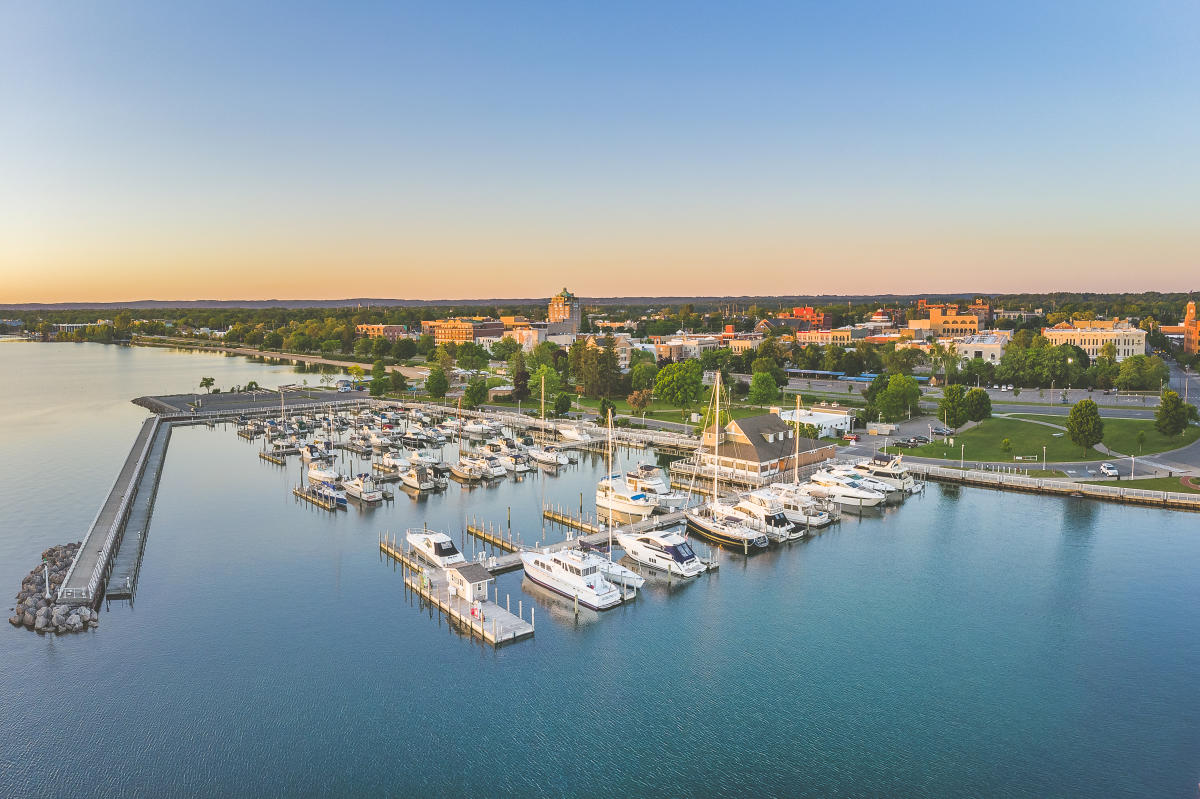
Traverse City anchors the top of Michigan's Lower Peninsula, wrapped around the base of Grand Traverse Bay where it meets Lake Michigan's northeastern shoulder. The bay splits into two arms — West Bay and East Bay — divided by the slender finger of Old Mission Peninsula reaching north from downtown. To the west lie Leelanau County and the dunes; to the east, the lakes and rolling farm country of Antrim and Kalkaska.
The city itself is small — home to around 15,000 people — but it's the hub of a four-county metro region of roughly 155,000, and the unquestioned commercial, cultural, and medical center of northern Michigan. That combination is much of the appeal: a genuinely walkable, well-provisioned town with the amenities of a small city, set against a landscape that feels remote and unspoiled the moment you leave the center.
One practical note that surprises newcomers: much of what people call "Traverse City" actually lies in the surrounding townships — Garfield, East Bay, Peninsula, and others — rather than inside the city limits. Your address, your taxes, and your services can differ meaningfully depending on which side of a line you land on, which is one of the first things a local agent will help you sort out.
A tale of many neighborhoods
Where you land depends a great deal on what you're after — in-town walkability, waterfront, acreage, or a shorter commute at a gentler price.
The historic core. The Central Neighborhood, Boardman, and Slabtown offer tree-lined streets, century-old homes, and the rare northern-Michigan luxury of walking to dinner, the farmers market, and the beach. These are among the most sought-after — and most tightly held — addresses in the region, prized by buyers who want to leave the car in the garage.
Downtown and the newer districts. For those who want a lock-and-leave lifestyle, condos and lofts in and around downtown, the Warehouse District, and the emerging Boardman Lake District put restaurants, trails, and the water within a short walk. It's a lifestyle that barely existed here a generation ago and now draws downsizers and professionals alike.
The Village at Grand Traverse Commons. A beautifully repurposed former state-hospital campus just west of downtown, "the Commons" is now a landscape of shops, restaurants, and distinctive residences inside the historic buildings — a one-of-a-kind place to live for buyers who want character and walkability together.
The west side and inland lakes. Just west and southwest of town, Oak Park, the Kids Creek area, and neighborhoods around Long Lake and Silver Lake trade a little in-town walkability for more yard, water access, and a slightly softer price.
The bay shores. Waterfront and water-view homes along East Bay and West Bay command the top of the market, from historic cottages to contemporary builds. Old Mission Peninsula — vineyards, orchards, and shoreline down its length — is a world of its own just minutes from downtown.
The Leelanau Peninsula. Just west of the city, Leelanau is its own county and, in many ways, its own world — a string of harbor villages and rolling wine country running out toward Sleeping Bear. Suttons Bay, Leland, Northport, and Glen Arbor, along with the inland communities of Cedar, Lake Leelanau, and Empire, each carry a distinct character, from working harbors to gallery-lined main streets to some of the region's most coveted waterfront. Plenty of buyers who work or spend their time in Traverse City choose to live out here for the scenery and the slower pace, trading a longer drive for one of the most beautiful corners of the Midwest. (We cover it in depth in our complete guide to living in Leelanau County.)
The surrounding communities. Many families find the best value just beyond the city: Acme and Williamsburg to the east, near the resorts, the airport, and Flintfields Horse Park; Interlochen to the southwest, with its lakes, woods, and famous arts academy; and Kingsley and the Chums Corner area to the south, offering small-town living and more land for the money. Each trades a few minutes of drive time for space, quiet, or price.
A closer look at each of these areas is coming in our Traverse City neighborhoods series.
The housing market at a glance
Traverse City real estate has, for years now, marched to its own drum. While much of the country cooled, this market stayed firm — buoyed by limited inventory, a steady influx of buyers from Chicago, Detroit, and both coasts, and an unusually high share of cash purchases from equity-rich retirees and relocating professionals.
The result is a market that sits comfortably above both the Michigan and national averages, with the county's median sale price holding in the low-to-mid $400,000s through 2026 — and waterfront, Old Mission, and Leelanau properties reaching well beyond that. Homes span a wide range, from in-town condos and starter houses to multimillion-dollar estates on the water.
Inventory here is also seasonal. Listings tend to swell from late spring through summer and thin out over the winter, which shapes both when you'll have the most to choose from and when you may face the least competition. Because the numbers move month to month, we keep them current in our regular Traverse City market reports rather than freezing a figure here. If you're planning a purchase or sale, that's the place to check the latest — or reach out and we'll walk you through exactly where things stand for your price point and neighborhood.
Property taxes: what buyers should understand
Property taxes are one of the most misunderstood parts of buying in Michigan, and they deserve a close look before you fall for a listing.
Two features matter most. First, Michigan offers a Principal Residence Exemption (PRE) for homes you own and occupy as your primary residence, which removes a meaningful slice of local school operating taxes from the bill. A second home or investment property doesn't qualify and is taxed at the higher "non-homestead" rate — an important line item for anyone eyeing a vacation cottage or rental.
Second, Michigan caps how much a property's taxable value can rise each year while you own it. When a home sells, that value "uncaps" and resets closer to current market value for the new owner. The practical result: the taxes the current owner pays can be well below what you'll pay after closing. Never budget from the seller's tax figure — always have your agent estimate the post-sale, uncapped amount.
Exact millage rates vary by township and school district, so confirm current figures with the local assessor, and loop in a tax professional for anything specific to your situation. It's an area where a knowledgeable local agent saves clients from real surprises.
What it costs to live here
Traverse City is not an inexpensive place by Michigan standards, and it's honest to say so. The overall cost of living runs roughly 10% above the national average, and nearly all of that premium is housing — groceries, utilities, and everyday expenses are close to typical. Median household income sits near $74,000, and the local economy has broadened well beyond its tourism roots.
A few practical realities shape day-to-day costs, especially outside the city core. Homes in town typically have municipal water and sewer, while many properties in the townships rely on a private well and septic system — well worth understanding and inspecting before you buy. Heating may be natural gas in developed areas or propane further out. And for the growing remote-work crowd, broadband is the question to ask early: service is excellent in and near town and improving in rural areas, but it still varies address by address.
What you're buying with the premium is, in a word, place: four-season access to water and trails, a downtown worth walking, a genuine food culture, and a community people actively choose rather than simply land in. For many transplants — particularly those bringing equity or remote income from a higher-cost city — the math works comfortably in their favor.
The four seasons, honestly
The single biggest question relocating buyers ask is about winter, so let's start there.
Winter is real. Sitting in the lake-effect belt off Lake Michigan, Traverse City averages around 100 inches of snow in a typical winter — and recent seasons have run well past that. The season is long, roughly December through March. But it's also, for many, part of the draw: Nordic and downhill skiing minutes from town, frozen-bay sunsets, quiet snowshoe mornings, and a downtown that stays lively through the cold. The people who thrive here tend to be the ones who lean into winter rather than merely endure it.
Spring arrives slowly and then all at once — the orchards blossom, the bay thaws, and the town exhales.
Summer is the postcard: warm days, cool nights, and some of the best freshwater beaches in the country. Sitting on the 45th parallel, the town enjoys remarkably long daylight, with summer light lingering past 10 p.m. It's also the busy season, when the population swells with visitors and second-home owners — more on that below.
Autumn may be the region's best-kept secret: crisp air, spectacular color across the hills and peninsulas, harvest in full swing, and the summer crowds gone home. Many longtime residents will tell you fall is the reason they stay.
There's a deeper logic to all this weather, too. The same lake-effect that piles up winter snow also moderates the extremes and creates the region's famous "fruit belt" microclimate — the reason cherries, wine grapes, and orchards flourish here and earn Traverse City its title as the Cherry Capital of the World.
Food, wine, and drink
For a town its size, Traverse City eats extraordinarily well. Decades of farm-to-table momentum, a serious wine industry, and an abundance of local growers have produced a dining scene that punches far above its weight, from downtown chef-driven restaurants to lakeside taprooms and one of the region's beloved traditions — a genuinely excellent, year-round farmers market.
The wine is no afterthought. Two established trails — one on Old Mission Peninsula, one across Leelanau — have earned the region a national reputation, particularly for cool-climate whites and sparkling wines. Add a deep bench of craft breweries, cideries, and distilleries, and you have a true culinary destination that residents get to enjoy on an ordinary Tuesday.
That culture now has a marquee celebration of its own: Traverse City Food & Wine, a five-day festival held each August that spreads dozens of tastings, chef demonstrations, farm dinners, and winery events across the region — anchored by the Grand Tasting on the bay at the Traverse City Open Space, with more than 100 local wines and nationally known chefs. Launched in 2025, it drew visitors from more than 30 states in its first year and has quickly become a fixture of the late-summer calendar.
Arts, culture, and community
Culturally, the city carries more than its weight. Downtown anchors include the lovingly restored State Theatre and the historic City Opera House. The Dennos Museum Center on the Northwestern Michigan College campus brings rotating exhibitions and a notable Inuit art collection. The National Writers Series draws acclaimed authors to the City Opera House stage throughout the year, and the Traverse Area District Library is a genuine community hub.
The calendar fills quickly: the National Cherry Festival each July, the Traverse City Film Festival, a spirited Restaurant Week, and summer concert and music events across town. Summer also brings the Traverse City Horse Shows at Flintfields Horse Park in nearby Williamsburg — a 13-week season of Olympic-level show jumping that runs from June into September, drawing world-class riders and a well-heeled crowd of spectators from across the country. It has grown into one of North America's premier equestrian destinations, and its weekend Grand Prix events, open to the public, have become a genuine social fixture of the northern-Michigan summer. Just southwest, Interlochen Center for the Arts — a world-renowned academy and summer camp — draws performers and students from around the globe and offers a year-round schedule of concerts open to the public. For a small northern town, the cultural life is unusually deep.
The outdoors
This is, ultimately, why most people come. Traverse City is a launch point for some of the Midwest's finest outdoor country. Sleeping Bear Dunes National Lakeshore — repeatedly named among America's most beautiful places — is a short drive west. The TART Trail network and the newer Boardman Lake Loop put paved cycling and walking paths right through town, while the VASA Pathway offers miles of trails for mountain biking and cross-country skiing.
The water is ever-present: sailing and boating on the bays, paddling the Boardman River, world-class fishing, and beaches from the in-town Clinch Park and West End Beach to quieter stretches up the peninsulas. In winter, downhill skiing at nearby resorts and Nordic trails minutes from downtown keep the season active. It's the kind of place where a full afternoon outdoors doesn't require a road trip — it requires stepping out the door.
Living with the seasons of tourism
It would be incomplete to describe Traverse City without acknowledging the summer swell. This is a beloved destination, and from roughly June through August — and especially during Cherry Festival week — the population climbs, the restaurants fill, and traffic on US-31 and M-72 slows to a crawl at peak hours.
For most residents, this is a manageable tradeoff rather than a dealbreaker. Locals learn the rhythms: where to launch the boat before the crowds, which back roads skip the congestion, when to book a table. And the flip side is a town that, for a small place, offers an outsized wealth of restaurants, culture, and events precisely because so many people want to be here. By September, the pace eases and the town settles back into itself.
Work, healthcare, and the economy
Traverse City's economy is more diverse than its resort-town reputation suggests. Munson Healthcare, anchored by Munson Medical Center, is the region's largest employer and the major referral hospital for all of northern Michigan — a meaningful reassurance for retirees and families, and a genuine asset in a rural region. Agriculture and the wine industry, advanced manufacturing, tourism and hospitality, and a growing professional and remote-work sector round out the picture.
That last piece has reshaped the town. A significant share of the regional workforce now works remotely or in hybrid roles, bringing income earned elsewhere into a community people genuinely want to live in. For many recent transplants, Traverse City isn't where the job is — it's where they've chosen to do the job from.
Schools and higher education
Families are well served here. Traverse City Area Public Schools (TCAPS) is the region's largest district, complemented by several private, parochial, and charter options. Northwestern Michigan College offers two-year degrees, transfer programs, and specialized training — including a distinctive Great Lakes maritime academy on the water. And Interlochen Arts Academy brings a globally recognized arts boarding school to the area's doorstep.
Family life
Beyond the schools, Traverse City is an easy place to raise a family. The Grand Traverse County Civic Center offers ice arenas, fields, a pool, and open green space near the heart of town; the Great Lakes Children's Museum on West Bay is a rainy-day favorite; and the district library system runs robust youth programming. Youth sports, summer camps, and beach days are woven into the calendar, and the region consistently posts crime rates well below big-city norms — part of why so many families feel comfortable letting kids roam a little more freely here.
Getting here and getting around
Cherry Capital Airport (TVC) sits minutes from downtown and offers direct service to major hubs including Chicago, Detroit, and Minneapolis, plus seasonal routes beyond — a genuine convenience for a town this size, and a big reason the second-home market stays strong. By car, Traverse City is roughly four to four-and-a-half hours from both Detroit and Grand Rapids, and about five to six from Chicago, which makes it an easy long-weekend destination.
In town, the core is walkable and bike-friendly, with the TART trails connecting many neighborhoods to downtown. Outside the center, you'll want a car — and in winter, one that's comfortable in snow. Summer traffic aside, getting around is easy the rest of the year.
How the market works for out-of-area buyers
A large share of buyers here arrive from somewhere else — often shopping on a compressed timeline built around a few visits north, or purchasing largely remotely. That's very doable in this market, but it puts a premium on local knowledge: which neighborhoods hold value, how a property's taxes will change after closing, what a waterfront listing's frontage really offers, and which "10-minute drive" becomes a 40-minute slog in July. A good local agent turns a handful of trips into a confident decision — and often spots the issues, and the opportunities, that aren't visible from a listing photo.
Is Traverse City right for you?
The people who put down roots here tend to share a few traits. They value access to nature over proximity to a big city. They're willing to trade some convenience and some cost for beauty, community, and pace. And — crucially — they embrace all four seasons, winter included, rather than wishing three of them away.
If that sounds like you, Traverse City rewards the choice richly. It's a place that asks a little more of its residents and gives a great deal back: a town small enough to feel like home and rich enough to keep surprising you, year after year.
Frequently asked questions about living in Traverse City
Is Traverse City a good place to live? For the right person, exceptionally so. It pairs genuine natural beauty and outdoor access with a walkable downtown, a strong food and wine culture, good healthcare, and a real sense of community. The main tradeoffs are cost — housing runs above the state and national averages — and long, snowy winters that reward people who enjoy the cold season.
How cold and snowy are the winters? Winters are cold and genuinely snowy, averaging around 100 inches of snow in a typical year thanks to lake-effect off Lake Michigan, with the season running roughly December through March. The upside is world-class winter recreation minutes from town.
Is Traverse City expensive to live in? It's above average for Michigan, with a cost of living roughly 10% over the national average — driven almost entirely by housing. Everyday costs like groceries and utilities are close to typical.
What is the housing market like? Competitive and resilient, with limited inventory, strong demand from out-of-area buyers, and a high share of cash purchases. Prices sit well above state and national averages, especially for waterfront. Our regular market reports track the current numbers.
Do you need a car in Traverse City? Downtown and the historic core are walkable and bike-friendly, but for most of the region a car is essential — ideally one that handles snow well in winter.
Is Traverse City a good place to retire? Many retirees choose it for the lifestyle, the strong regional hospital in Munson, and the four-season recreation. Winters and the cost of housing are the main factors to weigh.
What's the job market like? The economy centers on healthcare, agriculture and wine, manufacturing, and tourism, with a fast-growing remote and hybrid workforce. Many newer residents bring their jobs with them rather than seeking work locally.
Thinking about making the move? The Ted Schweitzer Group has helped buyers and sellers across Traverse City, Old Mission Peninsula, and Leelanau find their place in the north — and we know these neighborhoods block by block. Reach out anytime to start the conversation.
Check out this article next