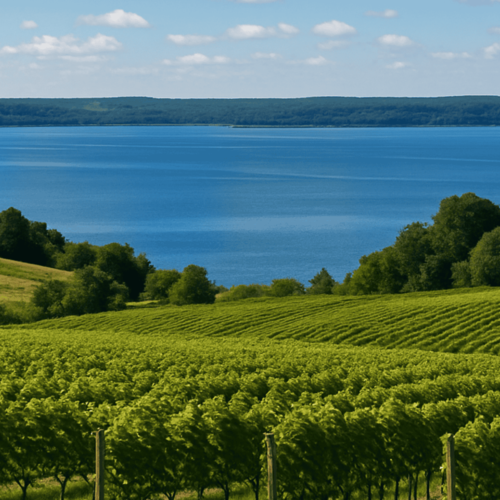


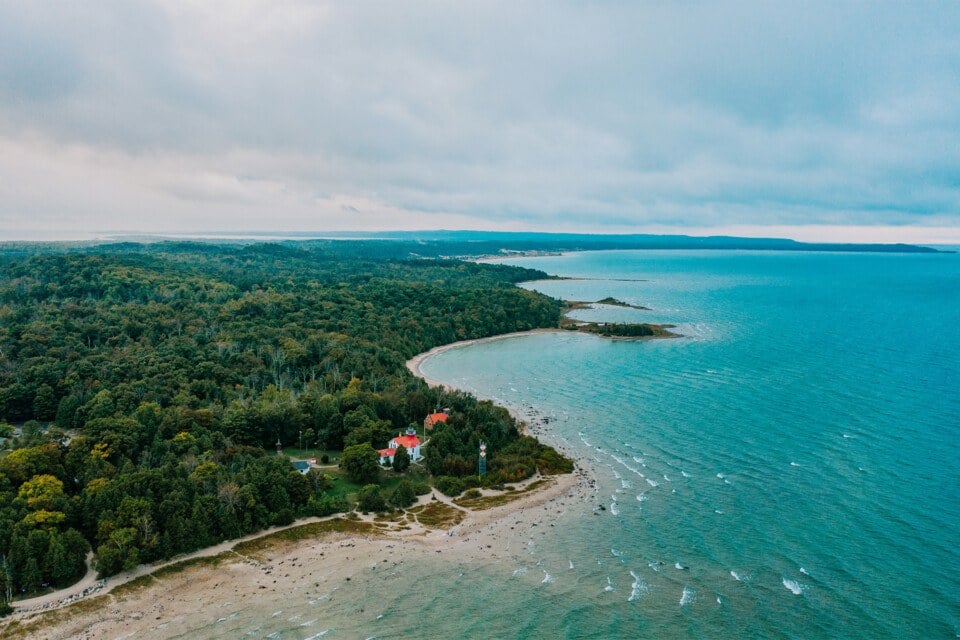
Grand Traverse Bay waterfront homes are among the most sought after properties in Northern Michigan, and for good reason. The water is clear enough to read depth by color. The shoreline runs from cobble to soft sand within the space of a few miles. Downtown Traverse City sits at the base of the bay, close enough that a waterfront owner on Old Mission Peninsula can be at dinner in twenty minutes and back on the dock by sunset.
What surprises most buyers is how different two properties can be while looking nearly identical on paper. Two homes on Grand Traverse Bay, priced within a hundred thousand dollars of each other, each with 100 feet of frontage, can deliver entirely different ownership experiences. One has a sand bottom that stays shallow for sixty feet and a west-facing deck that catches every sunset. The other has a cobble shelf, a four foot drop at the waterline, a north exposure that takes the brunt of a fall storm, and eighteen stairs down a bluff.
Neither is better. They are simply different properties for different buyers. The MLS sheet will not tell you which is which.
This guide covers what experienced buyers evaluate before they write an offer on Grand Traverse Bay waterfront real estate: orientation, shoreline composition, water depth, exposure, elevation, riparian rights, utilities, insurance, taxes, seasonal access and local regulation. Much of it applies anywhere on the Great Lakes. Some of it is specific to this bay.
What Makes Grand Traverse Bay Waterfront Unique?
Grand Traverse Bay is a large arm of Lake Michigan that extends roughly 32 miles south into the northwestern Lower Peninsula. Old Mission Peninsula, an 18 mile finger of orchard and vineyard land, divides the bay into two arms: East Grand Traverse Bay and West Grand Traverse Bay. Traverse City sits at the southern end, where both arms meet the mainland.
That geography is the reason waterfront here behaves the way it does.
Because each arm is long, narrow and oriented roughly north to south, wind has a long fetch to build waves from the north and a much shorter one from the east or west. A property's exposure depends less on how much water is in front of it and more on which direction that water runs. A protected cove on the east side of Old Mission can be glass at the same hour that the west shore of East Bay is running two foot chop.
The bay is also deep. West Grand Traverse Bay exceeds 600 feet in places, which means water temperature, clarity and ice behavior vary considerably from the shallow south ends to the deeper northern reaches. Buyers who have owned on smaller inland lakes are often recalibrating their expectations here, in both directions.
Three factors do most of the work in separating one Grand Traverse Bay property from another:
- Orientation. Which way the frontage faces determines light, wind, wave action and how the outdoor living space actually gets used.
- Location within the bay. Proximity to town, to a marina, to a plowed county road, to a protected harbor.
- Shoreline composition and elevation. What the bottom is made of, how quickly it drops, and how far the house sits above the water.
Everything else in this guide is a variation on those three.
[INTERNAL LINK: Traverse City real estate → /traverse-city-real-estate/]
East Bay vs. West Bay: How Do the Two Arms of Grand Traverse Bay Compare?
Neither arm is objectively better. They attract different buyers for structural reasons, and understanding those reasons is usually the fastest way for a buyer to narrow a search.
East Grand Traverse Bay
East Grand Traverse Bay runs from Traverse City north past Acme and Williamsburg on the east shore, up toward Elk Rapids and the Antrim County line, with Old Mission Peninsula forming its western edge.
What tends to define it:
- Sunset views across the water. From the east shore, the sun sets over Old Mission Peninsula and the bay. This is the single most common reason buyers gravitate to East Bay.
- More sand. Long stretches of the east shore, particularly through Acme and toward Elk Rapids, have shallower, sandier entry than much of the west side. Not universally, but often.
- Broader range of price points. East Bay inventory spans modest cottages to significant estates, which makes it the more accessible side for many buyers entering Grand Traverse Bay waterfront real estate for the first time.
- Proximity to golf, resort amenities and Elk Rapids. The Acme and Williamsburg corridor concentrates resort and golf development, and Elk Rapids offers a walkable village with a marina and harbor.
- Old Mission Peninsula frontage. The western shore of East Bay is Old Mission, which is a different proposition entirely: vineyards, orchards, larger parcels, more privacy, and sunrise rather than sunset exposure.
West Grand Traverse Bay
West Grand Traverse Bay runs from Traverse City north along the Leelanau Peninsula through Suttons Bay and Northport, with Old Mission forming its eastern edge.
What tends to define it:
- Sunrise over the water and dramatic evening light on the hills. East-facing frontage on the Leelanau side means morning sun on the water and long golden light on the bluffs behind you at day's end.
- More elevation and bluff frontage. The Leelanau shoreline climbs. Many West Bay properties sit well above the water with panoramic views and stair access to the beach.
- Leelanau County character. Wineries, small villages, farm parcels, and a slower and more agricultural feel than the resort corridor on East Bay.
- Suttons Bay and Northport as anchors. Suttons Bay in particular has a protected harbor, a village center and a strong second-home community.
- Generally tighter inventory. There is simply less shoreline available in some of the most desirable West Bay stretches, and turnover can be slow.
So which side should you buy on?
The practical answer, and the one most experienced local buyers arrive at:
- Choose East Bay if sunsets over water, sandier walk-in shoreline and proximity to Acme, Williamsburg or Elk Rapids matter most.
- Choose West Bay if you want elevation, long views, Leelanau County character and morning light, and you are comfortable with stairs or a bluff.
- Choose Old Mission Peninsula if you want acreage, agricultural surroundings, relative privacy and a location that is still fifteen to twenty-five minutes from downtown Traverse City.
The East Bay vs. West Bay question is often settled in a single day of showings. Buyers tend to know within a few hours which side feels like theirs.
[INTERNAL LINK: Old Mission Peninsula real estate → /old-mission-peninsula-real-estate/] [INTERNAL LINK: Leelanau County real estate → /leelanau-county-real-estate/]
Why Does Waterfront Orientation Matter So Much?
Orientation determines when you get sun, how hard the wind hits, how rough the water gets, and whether your dock stays in the water through a September blow.
West-facing frontage (much of the East Bay shoreline, including Acme and Williamsburg) delivers sunsets over the water and warm afternoon and evening light on the deck. It also takes westerly wind, which on this bay usually means moderate chop rather than sustained wave action, because the fetch across each arm is limited.
East-facing frontage (the Leelanau shoreline of West Bay, and the east side of Old Mission) gets sunrise over the water, cooler and more comfortable afternoons on the water side of the house, and evening light on the land behind you. Boats and docks on east-facing shoreline are generally sheltered from prevailing westerlies.
North-facing frontage is where exposure deserves the most scrutiny. Both arms of Grand Traverse Bay open to the north, so a northerly wind has the entire length of the bay to build. Northern exposure can mean the most dramatic water and the hardest conditions during fall storms and spring ice movement.
South-facing frontage is uncommon on the main bay and usually found in coves, harbors and the bay's southern pockets. It tends to be the most protected and the warmest, often with shallower and warmer water.
Practical advice: visit a waterfront property more than once, at different times of day, and ideally in different weather. Morning sun and evening sun change a house completely. A calm July afternoon and a windy October morning can look like two different pieces of shoreline. If you are seriously considering a property, ask for photographs from the seller across multiple seasons, and ask neighbors what the water does in a northerly.
Why Is Not All Waterfront Footage Equal?
Frontage is measured in feet. It is experienced in usability. One hundred feet of frontage can mean a wide sand shelf your kids never leave, or it can mean a rock shelf, a steep drop and no real place to set a chair.
Here is what actually differentiates frontage:
- Bottom composition. Sand, pea gravel, cobble, shale shelf, or a mix. Sand and small gravel are the most comfortable underfoot. Cobble and shale are stable and low maintenance but hard on bare feet and difficult for small children.
- Entry gradient. A gradual entry gives you a long shallow wading area. A quick drop-off gives you swimmable and dockable depth right off the shore. Both are desirable, to different buyers.
- Usable beach area. Measured not in deed feet but in how much dry, level shoreline exists between the water and the vegetation or bank at typical water levels.
- Water depth at the dock line. This determines what boat the property can accommodate, which is a threshold issue for many buyers.
- Elevation and bank type. Walkout grade, low bank, moderate slope, or high bluff.
- Vegetation. Natural shoreline plantings stabilize soil and are often encouraged or required by local ordinance. Mature trees can also mean that a view exists only where it has been carefully cut.
- Neighboring docks and structures. How close they sit, how far they extend, and whether they affect your privacy, your swimming area or your approach to your own dock.
- Shoreline protection already in place. A seawall or revetment changes how the shoreline behaves and carries its own maintenance and permitting history.
- Privacy. Distance from neighboring homes, screening vegetation, and how visible your shoreline is from adjacent properties and from the water.
Two properties with identical frontage figures can differ by a factor of ten in usable shoreline. This is the single most common gap between what buyers expect from an online listing and what they find on site.
[INTERNAL LINK: waterfront homes for sale → /waterfront-homes-for-sale/]
Bluff Waterfront vs. Walkout Waterfront: What Is the Difference?
Walkout waterfront means the home sits at or near the elevation of the shoreline, and you can step from the living space to the water without significant stairs. Bluff waterfront means the home sits meaningfully above the water, with stair access down to the beach and dock.
Walkout frontage tends to offer:
- Immediate access to the water for children, guests and anyone with mobility limitations
- A closer relationship between indoor and outdoor living
- Simpler day to day use: no hauling coolers, kayaks or grandchildren up and down stairs
- Lower elevation, which means more attention to drainage, moisture and high water years
Bluff frontage tends to offer:
- Longer, wider views across the bay, often above the tree line
- More privacy from the water and from neighbors
- Better separation from high water and wave action
- A stair system that becomes a real consideration over time
For buyers planning to age in place, or planning for a property that will serve three generations, this distinction matters more than almost any other feature. A stairway of forty or sixty steps is a pleasure at forty-five and a limiting factor at seventy-five. Some bluff properties have tram or funicular systems, which solve the access problem and introduce a mechanical system that needs inspection, maintenance and eventual replacement.
Bluff properties also require attention to bank stability. Ask when the stairs were built, whether the bank has moved, whether any engineering work has been done, and whether the parcel falls within a designated high risk erosion area.
Docks and Boating on Grand Traverse Bay: What Should Buyers Investigate?
Start with the simple questions:
- Is there an existing dock, and does it convey?
- Is it seasonal or permanent? Most residential docks on the bay come out in the fall and go back in each spring.
- Who installs and removes it, and what does that cost annually?
- How deep is the water at the end of the dock, at typical and low water levels?
- What size boat has actually been kept there? This is a better question than asking what could fit.
- Is there a boat lift, and does it convey? Lifts are exposed to ice and need periodic service.
- How protected is the shoreline? A dock on an exposed north-facing shore lives a harder life than one tucked into a cove.
On permitting, the general framework in Michigan is this. Michigan's Department of Environment, Great Lakes, and Energy (EGLE) does not require a permit for a seasonal dock or hoist that is placed for private, noncommercial use by the landowner, removed at the end of the season, does not unreasonably interfere with others' use of the water, and is not placed in a wetland. Permanent structures placed on Great Lakes bottomlands are a different matter and are regulated under Part 325 of the Natural Resources and Environmental Protection Act, the Great Lakes Submerged Lands Act, because the state holds Great Lakes bottomlands in public trust.
Two practical cautions follow from that. First, a permanent dock that was permitted decades ago may not match what is in the water today if a previous owner extended it, replaced cribs or added a finger. Second, township and county rules can apply on top of state rules, and some townships regulate shared or funneled access to the water more strictly than the state does.
Verify dock and shoreline questions with EGLE and with the relevant township or municipality before closing. This is general information and not legal advice.
For buyers who want deeper water and larger vessels without buying the deepest lot, marina slips are available in Traverse City, Elk Rapids, Suttons Bay and Northport. Slip availability varies year to year and often carries a waiting list.
Riparian Rights and Waterfront Boundaries in Michigan
Waterfront ownership in Michigan is not a single, uniform thing. Before writing an offer, a buyer should know exactly which of the following they are purchasing:
- Private deeded frontage. The parcel itself includes the shoreline.
- Shared frontage. Multiple parcels hold rights to a common stretch of shoreline, usually with defined terms.
- Association or easement access. The home is not on the water, but has a legal right of access, sometimes with dock rights and sometimes without.
- Access by easement across another parcel. Terms, maintenance obligations and permitted uses vary widely.
These are materially different products at materially different values, and listing language does not always distinguish them clearly. A survey and a title commitment review are the tools that settle the question.
Two Michigan-specific points worth understanding on Great Lakes frontage:
The public trust doctrine applies below the ordinary high water mark. In Glass v. Goeckel (2005), the Michigan Supreme Court held that the public may walk along the Great Lakes shoreline below the ordinary high water mark, even where the adjacent land is privately owned. A Great Lakes waterfront owner may hold title toward the water's edge while the land below that mark remains subject to public trust rights. This surprises buyers arriving from markets where private beach means exclusive beach.
The ordinary high water mark has more than one meaning. The court in Glass described a natural, physical mark left by the continuous presence and action of water. Part 325 separately sets a statutory elevation for Lakes Michigan and Huron. Those two marks do not always fall in the same place, which matters for permitting shoreline work.
Confirm boundaries with a current survey, confirm access rights with your title company and a Michigan real estate attorney, and confirm anything touching the shoreline itself with EGLE. Nothing in this section is legal advice.
[INTERNAL LINK: buyer's guide → /buyers-guide/]
How Do Great Lakes Water Levels Affect Grand Traverse Bay Property?
Great Lakes water levels fluctuate, and the swing is larger than most buyers expect.
Lake Michigan and Lake Huron are hydrologically one lake, measured as Lake Michigan-Huron. According to NOAA's Great Lakes Environmental Research Laboratory and the University of Michigan's GLISA program, the basin set an all time record low monthly mean water level in January 2013, then rose rapidly through the following years to reach record monthly highs in 2020, and has generally been declining since. The full recorded range since 1918 is a little over six feet.
Six feet of vertical change on a gradual shoreline can move the waterline horizontally by a remarkable distance. Practically:
- During low water years, beaches widen, sandbars emerge, docks may need extensions, and shallow entries can become too shallow to launch from.
- During high water years, beaches disappear, wave energy reaches structures that were previously well back from the water, bluff toes erode, and shoreline protection gets tested.
This is why judging a property by one showing on one July afternoon is risky. A shoreline that looks generous in a low water year may have been underwater in 2020.
What to investigate:
- Historical aerial imagery of the parcel across multiple years, which is publicly available and often revealing
- Photographs from the seller during high water periods
- Neighboring shoreline conditions, since erosion patterns rarely stop at a property line
- Whether the parcel falls within a designated high risk erosion area
On that last point: under Part 323 of Michigan's Natural Resources and Environmental Protection Act, EGLE designates high risk erosion areas along the Great Lakes where the long term recession rate is one foot or more per year. On a parcel with any portion designated, a permit is required to build or move a permanent structure, and EGLE applies 30 year and 60 year setback distances depending on whether the structure can be readily moved. EGLE publishes maps of designated areas. Whether a specific parcel is affected is a parcel-level question, and it should be answered during due diligence rather than assumed either way.
Seawalls and Shoreline Protection: Asset or Liability?
Both, depending on condition and history.
A well built and properly permitted seawall or revetment can protect a bank, preserve usable yard and give a buyer confidence during high water periods. A failing one can be an expensive problem that is difficult and slow to replace, because work on Great Lakes bottomlands and below the ordinary high water mark is regulated by EGLE and often requires joint review with the U.S. Army Corps of Engineers.
What to ask:
- When was it built, and by whom?
- Is there documentation of the permits issued at the time?
- Has it been repaired, and when?
- Is there evidence of undermining, settling, bulging or failure at the ends?
- What is behind it, and is the backfill still intact?
- What is the expected remaining service life, and what would replacement cost today?
Also worth knowing: natural and engineered "green" shoreline approaches, using native vegetation and stone rather than vertical wall, are increasingly encouraged in Michigan and are sometimes required or preferred at the local level. A property with a healthy natural shoreline is not a property missing an amenity.
Have shoreline structures evaluated by a marine contractor or coastal engineer, not only by a general home inspector.
Well, Septic and Municipal Utilities on Grand Traverse Bay
Utilities vary considerably around the bay. Properties inside Traverse City and portions of adjacent townships may be served by municipal water and sewer. Much of Old Mission Peninsula, Leelanau County and the outlying stretches of East Bay rely on private wells and on-site septic systems.
What buyers should establish:
- Which systems serve the property, confirmed in writing rather than assumed from the listing
- Age, size and condition of the septic system, including the drainfield
- When it was last pumped and last inspected, and by whom
- Whether a replacement drainfield location exists on the parcel, which is the question that matters most on small waterfront lots
- Well depth, age, flow rate and water quality testing, including arsenic and bacteria
- Whether municipal service is available at the road, and at what connection cost
Waterfront lots complicate septic work. Setbacks from surface water, lot size, slope, high water table and, on some parcels, high risk erosion area rules can all constrain where a system may be placed. A small lot with an old system and no viable replacement area is a real risk, and it is one that a standard home inspection will not surface. The Grand Traverse County Health Department and the Benzie-Leelanau District Health Department administer these programs locally and are the right places to verify.
Flood Insurance and Homeowners Insurance for Waterfront Property
Do not assume a waterfront home will insure like the house you own now. Get quotes during the inspection period, before contingencies are released.
Factors that commonly influence waterfront coverage and pricing:
- Whether the parcel sits within a FEMA designated Special Flood Hazard Area, which you can check on the FEMA Flood Map Service Center
- Elevation of the structure relative to the water and, where applicable, an elevation certificate
- Replacement cost of the home, which on custom waterfront construction can be well above purchase price
- Detached structures: boathouses, guest quarters, garages, stairs and decks
- Docks, lifts and shoreline structures, which are frequently excluded or separately rated
- Whether the home is occupied seasonally, which some carriers treat differently
- Wind and water exposure, roof age, and distance to a fire department
Lender requirements are separate from what is prudent. A property outside a mapped flood zone may still carry real water risk, and coverage decisions should be made with an agent who writes Northern Michigan waterfront regularly.
This is general information, not insurance advice. Specific coverage questions belong with a licensed insurance agent.
How Do Michigan Property Taxes Work for Waterfront Buyers?
Do not use the seller's current tax bill to estimate your future one. In Michigan, this is one of the most common and most expensive assumptions a buyer makes.
Under Proposal A of 1994, annual growth in a property's taxable value is capped while ownership stays the same. When a transfer of ownership occurs, taxable value uncaps in the calendar year following the transfer and resets, which can raise the tax bill significantly. On a long held waterfront property that has appreciated substantially, the difference between the seller's bill and the buyer's bill can be dramatic.
Two related points:
- Michigan's Principal Residence Exemption exempts an owner-occupied principal residence from up to 18 mills of local school operating tax. Second homes and vacation properties generally do not qualify, which raises the effective rate on the same property.
- Millage rates differ by municipality and school district, so two similar homes a few miles apart can carry different rates.
Estimate the post-sale figure with the assessor for the applicable city or township before you write the offer. The Michigan Department of Treasury publishes guidance on transfer of ownership and uncapping. This is general information and not tax advice.
Winter on Grand Traverse Bay: What Summer Buyers Do Not See
Buyers who have only visited in July are working with half the picture. A waterfront home lives a different life from November through April.
Wind and storms. Northerly wind on an exposed shoreline in late fall is a different experience from the same shoreline in August. Storm-driven spray and freeze can coat decks, railings, stairs and windows.
Ice. Shore ice builds and shifts. Ice movement can damage docks left in the water, seawalls, stairs and shoreline plantings. Whether and how fully a given stretch of the bay freezes varies year to year, and the deeper northern sections of West Bay often stay open when the shallower south ends and protected coves ice over.
Snow and access. Ask who plows, whether the road is county maintained or private, and what the last steep stretch of driveway looks like in February. Bluff properties with descending driveways deserve particular attention.
Dock removal. Budget for it annually, both in dollars and in scheduling.
Winterization. Seasonal-use owners need a plan for water lines, heat, humidity, and someone checking on the property. Freeze damage in an unoccupied waterfront home can be catastrophic.
Exterior maintenance. Lakeside elevations take more weather than the road side. Paint, stain, windows, doors, decks and railings on the water side wear faster.
Year-round buyers should try to see a property, or at least the road and the neighborhood, in winter. Many do not have that luxury. At minimum, ask the seller and the neighbors direct questions about how the property handles January.
[INTERNAL LINK: moving to Traverse City → /moving-to-traverse-city/]
Can You Use a Grand Traverse Bay Waterfront Home as a Short-Term Rental?
Sometimes, and it depends entirely on the municipality. Verify before you purchase, not after.
Michigan has no statewide law preempting local short-term rental regulation, so authority rests with cities and townships, and rules around Grand Traverse Bay differ meaningfully from one jurisdiction to the next. As examples of the range:
- The City of Traverse City distinguishes between whole-home rentals, licensed as Vacation Home Rentals and allowed only in certain non-residential zoning districts, and owner-present rentals, licensed as Tourist Home Rentals in residential districts.
- Several surrounding townships require licenses and some cap the total number issued, meaning availability can be effectively closed at the time you buy.
- Some townships have no specific short-term rental ordinance, in which case general zoning language and any private association or condominium documents govern.
Rules also change. Proposals were under discussion in Traverse City as recently as 2026. A property that pencils out as a rental under today's ordinance may sit in a district where the math changes.
If short-term rental income is part of your purchase rationale, confirm three things in writing before removing contingencies: the zoning district and whether the use is permitted there, current license availability and transferability, and any HOA, condominium or deed restrictions. Do not rely on a seller's representation of past rental income as evidence of future legality.
Renovating or Building on Grand Traverse Bay Waterfront
If your value proposition depends on what you plan to build, investigate before you buy, not after.
Common constraints on waterfront parcels:
- Setbacks, including shoreline setbacks that are often stricter than road-side setbacks
- Lot coverage and impervious surface limits, which some townships apply specifically near the lakeshore
- Building height limits, which can affect whether a second story achieves the view you are paying for
- Bluff and slope restrictions, and in designated high risk erosion areas, EGLE's 30 year and 60 year setbacks
- Septic limitations, including whether a compliant system can be sited for a larger home
- Wetlands, which are regulated by EGLE when connected to or within 500 feet of an inland lake or stream, or within 1,000 feet of a Great Lake
- Soil erosion and sedimentation control permits, required by Grand Traverse and Leelanau counties for earth change work near water
- Nonconforming status. Many older waterfront cottages sit closer to the water than current ordinance allows. They can often be maintained as they are, but expanding, or rebuilding after a substantial loss, may trigger current standards and pull the footprint back from the water.
That last point deserves emphasis. A charming 1950s cottage forty feet from the water may not be replaceable in the same location. Buyers planning a teardown should confirm the buildable envelope with the township zoning administrator before closing, and where relevant, with EGLE.
What Should a Waterfront Home Inspection Cover?
A standard inspection is a starting point. On waterfront, add attention to:
- Foundation and basement moisture, with particular attention to walkout and low-elevation homes
- Crawlspaces, for humidity, wood moisture content and any evidence of past water
- Drainage and grading, including where roof and surface water actually goes
- Seawall or revetment condition, ideally assessed by a marine contractor
- Bank and bluff stability, including any evidence of slumping or exposed roots
- Stairs and tram systems, including footings, stringers, railings and mechanical components
- Decks and railings on the water side, where weathering accelerates
- Dock and lift condition, including cribs, decking, hardware and electrical
- Exterior materials and windows, especially on the exposure that takes the weather
- Well water testing and septic inspection, with a dye or flow test where appropriate
- Boathouses and detached structures, which are often older and less maintained than the house
Budget for specialists. On a significant waterfront purchase, a marine contractor, a septic professional and sometimes a coastal or geotechnical engineer earn their fees several times over.
How Do You Compare Two Grand Traverse Bay Waterfront Homes?
Use the same criteria on every property. Buyers who do this reach a decision faster and with more conviction.
| Criteria | What to determine |
|---|---|
| Frontage | Actual measured feet, and whether private, shared or deeded access |
| Orientation | Which direction the frontage faces, and resulting light and wind exposure |
| Shoreline type | Sand, gravel, cobble, shale; gradual entry or drop-off |
| Water depth | Depth at the dock line at typical and low water |
| Exposure | Protection from prevailing and storm wind; wave and ice action |
| Dock suitability | Existing dock, seasonal or permanent, permit history, boat size supported |
| Elevation | Walkout, low bank, or bluff; number of stairs |
| Utilities | Municipal water and sewer, or well and septic with replacement area |
| Privacy | Distance and screening from neighbors; visibility from the water |
| Distance to town | Drive time to downtown Traverse City, groceries, medical, airport |
| Renovation potential | Zoning, setbacks, lot coverage, height limits, nonconforming status |
| Year-round access | Road maintenance, plowing, driveway grade |
| Taxes | Estimated post-sale taxable value and applicable millage |
| Insurance | Flood zone status and indicative premium |
Score each property on every line before comparing prices. Price differences that look irrational at first usually become clear once the grid is filled in.
15 Questions to Ask Before Buying Grand Traverse Bay Waterfront
- How many feet of actual, measured private frontage does the property have?
- Is the frontage private, shared, deeded or by easement?
- What direction does the frontage face, and what does that mean for light and wind?
- What is the shoreline composed of, and how quickly does it drop off?
- How deep is the water at the end of the dock, at typical and at low water levels?
- How exposed is this shoreline during a northerly storm?
- Has the shoreline eroded, and what does historical aerial imagery show?
- Is any portion of the parcel in a designated high risk erosion area?
- Are there permits on file for the dock, seawall or any shoreline structure, and do they match what exists today?
- Is the property on municipal water and sewer, or well and septic, and is there a viable replacement drainfield location?
- Are there easements, association rights or shared access affecting the waterfront?
- What are the zoning setbacks, height limits and lot coverage rules, and is the existing structure conforming?
- Is short-term rental use permitted in this zoning district, and are licenses currently available?
- What did this shoreline look like during the high water period around 2020?
- What will the property taxes be after the taxable value uncaps, and what will insurance cost?
Grand Traverse Bay Waterfront FAQ
Is East Grand Traverse Bay or West Grand Traverse Bay better? Neither is better. East Grand Traverse Bay is generally favored for sunset views over the water, sandier shoreline in many stretches, and proximity to Acme, Williamsburg and Elk Rapids. West Grand Traverse Bay is favored for elevation, long views, morning light and Leelanau County character through Suttons Bay and Northport. Old Mission Peninsula, which separates the two arms, offers acreage, vineyards and privacy with access to both sides.
How much does a waterfront home on Grand Traverse Bay cost? Prices vary widely and resist a single average. The factors that move price most are amount and quality of frontage, orientation, water depth, elevation, acreage, privacy, condition of the home and proximity to downtown Traverse City. Two properties with identical frontage figures can differ substantially in value because of shoreline composition and exposure. A current, parcel-level comparison is the only reliable way to understand pricing.
Can you have a dock on Grand Traverse Bay? In most cases, yes, if you hold riparian rights to the frontage. EGLE generally does not require a permit for a seasonal dock or hoist installed for private, noncommercial use that is removed at season's end and does not unreasonably interfere with others' use of the water. Permanent structures on Great Lakes bottomlands are regulated under Part 325, the Great Lakes Submerged Lands Act, and local rules may also apply. Verify with EGLE and the township.
Is Grand Traverse Bay good for boating? Yes. The bay is deep, large and connected directly to Lake Michigan, with marinas and harbors in Traverse City, Elk Rapids, Suttons Bay and Northport. Because both arms open north and have long fetch, conditions can change quickly with a northerly wind, which is why shoreline exposure and protected moorage matter when selecting a property.
Are Grand Traverse Bay beaches sandy? Some are. The shoreline is genuinely varied, ranging from soft sand to pea gravel to cobble to shale shelf, sometimes changing within a few hundred feet. Sandy frontage tends to be more common along portions of East Bay's eastern shore, but this is a property-by-property question, not a side-of-the-bay question.
Does Grand Traverse Bay freeze in winter? Partially, and it varies year to year. Shallower areas, protected coves and the southern ends of both arms freeze more readily and more often than the deeper open water, particularly in West Grand Traverse Bay. Full bay ice cover is not a given in any given winter. Shore ice movement is the more relevant concern for waterfront owners, because it can damage docks, seawalls and stairs.
Where are the best areas to buy waterfront property near Traverse City? It depends on what you want. Old Mission Peninsula for acreage and privacy. The Acme and Williamsburg corridor on East Bay for sunsets and resort amenities. Elk Rapids for a walkable village with a harbor. Suttons Bay and the Leelanau shoreline of West Bay for elevation, views and wine country. Inside Traverse City for walkability to downtown.
What is the difference between private waterfront and shared waterfront? Private waterfront means the parcel itself includes deeded frontage and the riparian rights that come with it. Shared or association waterfront means multiple owners hold rights to a common stretch of shoreline, often with defined rules about dock placement and use. The two are valued very differently, and listing language does not always make the distinction obvious. A survey and title review confirm which you are buying.
Do I need flood insurance for a Grand Traverse Bay home? It depends on the parcel. Whether flood insurance is required is generally driven by whether the property sits in a FEMA designated Special Flood Hazard Area and by lender requirements. Whether it is advisable is a separate question, since low-lying shoreline can carry real water risk outside a mapped zone. Check the FEMA Flood Map Service Center and obtain quotes during due diligence.
What should I look for when buying a waterfront home in Traverse City? Beyond the house: orientation, shoreline composition, water depth at the dock, storm exposure, elevation and stair count, condition and permit history of any shoreline protection, utilities and septic replacement capacity, zoning constraints on future work, short-term rental status if that matters, year-round road access, and the post-sale property tax and insurance picture.
Working With a Team That Knows This Shoreline
Waterfront buying comes down to details that are not visible in listing photos or MLS data. Orientation, shoreline composition, water depth, exposure, elevation, utilities and local regulation can matter as much as the house itself, and they are the reason two similar-looking properties on Grand Traverse Bay can be worth very different amounts to the same buyer.
The Ted Schweitzer Group works throughout Traverse City, Old Mission Peninsula, Leelanau County and the greater Grand Traverse region, on waterfront homes as well as vineyard and orchard properties, acreage and luxury homes. Much of what we do for waterfront buyers happens before a showing is scheduled: reading the shoreline, checking the exposure, understanding what a parcel will and will not allow.
If you are considering Grand Traverse Bay waterfront real estate, on East Bay, West Bay, Old Mission Peninsula or anywhere along the Northern Michigan shoreline, we are glad to help you evaluate specific properties. Reach out when you are ready.
Check out this article next